
Emergency, Urgent or Routine Repair? A Landlord’s Guide to Prioritising Maintenance

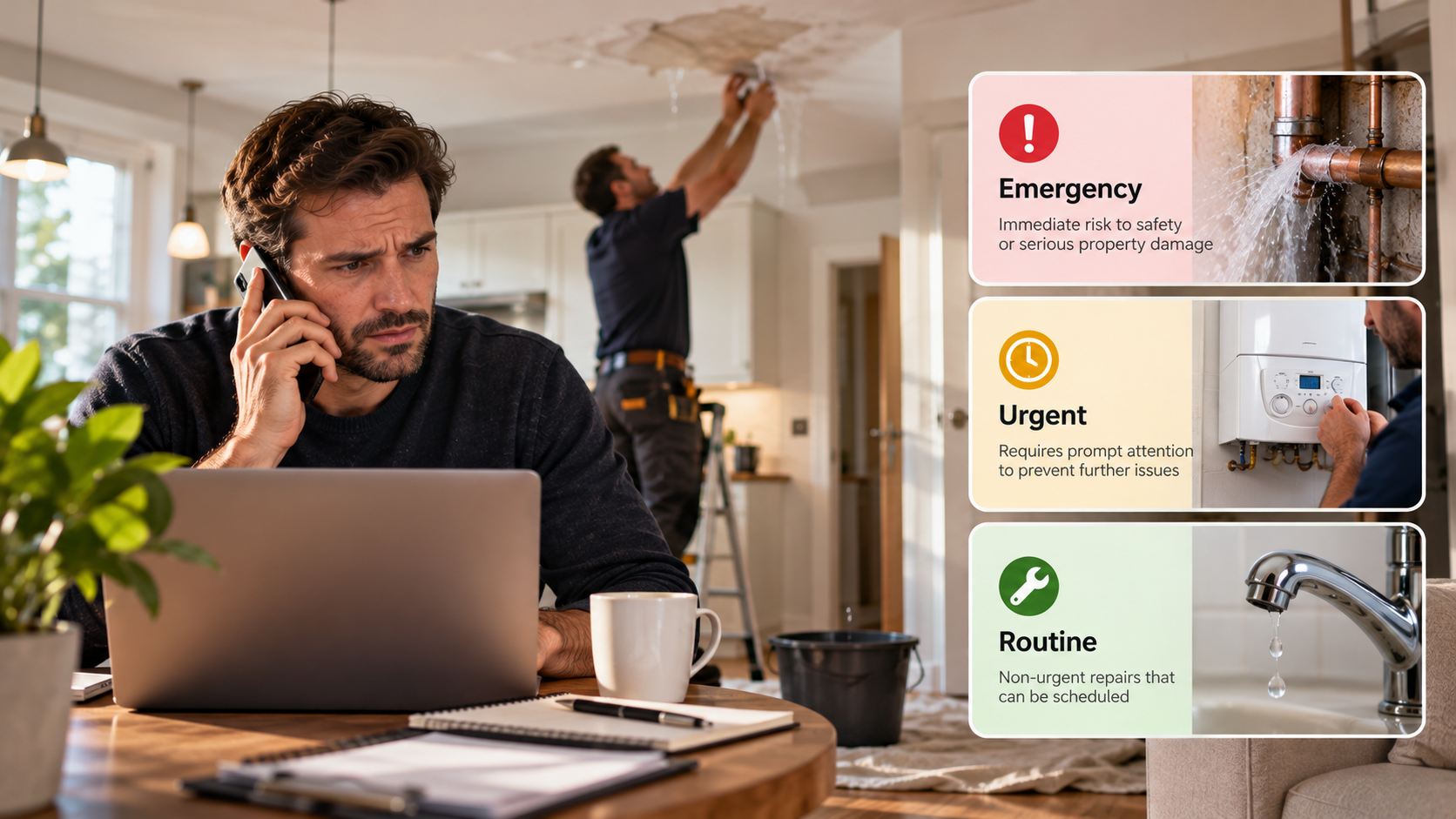
Emergency Repair and Property Maintenance starts with one critical decision when a tenant reports a problem: not simply who can fix it, but how quickly does it need to be fixed?
A dripping tap, complete loss of heating and a serious electrical fault are all maintenance issues, but they clearly should not sit in the same queue.
Knowing how to distinguish between an emergency, urgent and routine repair helps landlords respond appropriately, protect tenants, limit damage to the property and organise maintenance more efficiently. It can also prevent relatively manageable problems from escalating into disruptive and expensive repairs.
The challenge is that maintenance problems are not always easy to categorise. A small water leak might initially appear routine but become urgent if it is spreading. A boiler problem might be inconvenient during mild weather but considerably more serious during a cold spell. A blocked drain can move from an everyday maintenance issue to a potential hygiene problem very quickly.
This guide explains how landlords can assess maintenance requests, which warning signs should receive priority and how LandlordFix can make the process of organising repairs simpler.
Why Landlords Need a Maintenance Priority System
When you own a rental property, maintenance requests can arrive at any time. Some will require immediate attention, while others can reasonably be booked for a convenient date.
Treating every maintenance request as an emergency is inefficient. Treating everything as routine can be considerably more problematic.
A useful maintenance process considers several factors: whether anyone is at immediate risk, whether essential facilities have been affected, whether the problem is causing active damage to the property and whether delaying the repair is likely to make the situation substantially worse.
The objective is not to diagnose every problem personally. It is to recognise the level of risk and arrange the appropriate response.
A landlord who has a clear system for doing this is in a much stronger position than one making decisions from scratch every time the phone rings.
What Is an Emergency Repair?
An emergency repair generally involves a situation where there may be an immediate risk to health or safety, serious damage to the property or a problem that requires rapid intervention to prevent the situation deteriorating significantly.
The first priority in an emergency should always be safety.
Depending on the circumstances, emergency services or the relevant utility emergency service may need to be contacted before a maintenance professional. Landlords should not encourage tenants to investigate potentially dangerous gas or electrical problems themselves.
Examples of situations that may require emergency action include the following.
Major Uncontrolled Water Leaks
A significant water leak can cause substantial damage in a relatively short period.
Water may affect flooring, ceilings, walls, furniture, electrical installations and neighbouring properties. In flats, a leak can also spread into the property below.
If water is actively escaping, the immediate objective is usually to stop or isolate the source safely where possible and arrange professional assistance.
A minor drip beneath a sink and water pouring through a ceiling are clearly not equivalent situations. The amount of water, its location and the potential for further damage determine the urgency.
Serious Electrical Hazards
Reports of sparking, burning smells, exposed live wiring, smoke from electrical equipment or other indications of a potentially dangerous electrical fault should be treated seriously.
Electrical repairs should be handled by appropriately qualified professionals.
If there appears to be an immediate danger, the priority is making the situation safe rather than waiting for a standard maintenance appointment.
LandlordFix can help landlords arrange professional electrical services when electrical faults or repairs require attention.
Suspected Gas Leaks
A suspected gas leak requires an emergency response.
Tenants should follow current gas emergency guidance and contact the National Gas Emergency Service where appropriate. A suspected gas leak should not simply be submitted as an ordinary contractor job and left until the following day.
Gas appliances and associated work should only be handled by appropriately registered professionals.
Serious Structural Problems
A sudden ceiling collapse, major structural movement or another defect that appears to create an immediate physical danger requires urgent professional assessment.
Not every crack in a wall is a structural emergency. However, sudden or significant changes should not be casually dismissed without appropriate investigation.
Serious Security Problems
A damaged external door or lock can become an emergency where the property can no longer be secured.
The circumstances matter. A stiff lock that still operates is different from a front door that cannot be closed or locked at all.
Landlords should consider both the physical condition of the property and the tenant’s immediate security.
What Is an Urgent Repair?
An urgent repair is generally a problem that requires prompt attention but does not necessarily present an immediate danger at the time it is reported.
This is where good judgement becomes particularly important.
Leaving an urgent repair unresolved can affect the tenant’s ability to use the property normally, create further damage or allow the issue to develop into an emergency.
Loss of Heating During Cold Weather
A heating failure deserves prompt attention, particularly during colder periods.
The seriousness of the situation depends on factors including the outside temperature, the property, whether alternative heating is available and the occupants’ circumstances.
A boiler fault in August is not necessarily equivalent to a complete heating failure during a very cold January.
Landlords should therefore assess the actual situation rather than applying the same response time regardless of circumstances.
Loss of Hot Water
A complete loss of hot water is another issue that should not be allowed to drift indefinitely through a routine maintenance queue.
Investigate the problem and arrange appropriate professional attention.
If the loss of hot water is linked to a wider boiler or heating failure, the situation may need to be considered together rather than treated as two separate faults.
Leaks That Are Contained but Continuing
Not every leak constitutes an immediate emergency, but continuing water escape should rarely be ignored.
A slowly leaking pipe beneath a sink may initially be contained, but water can damage cabinets, flooring and surrounding materials over time.
The longer moisture remains where it should not be, the greater the potential for secondary problems.
Blocked Toilets and Drainage Problems
The urgency of a blocked toilet depends partly on the facilities available within the property.
If the property has several functioning toilets and one becomes blocked, the situation may be inconvenient without necessarily being an emergency.
If it is the property’s only toilet and cannot be used, the situation is considerably more serious.
Similarly, a slow-running drain may begin as a routine maintenance issue but become urgent if wastewater begins backing up.
Damp and Mould
Reports of damp or mould should be investigated rather than automatically treated as a cleaning issue.
The visible mould may be a symptom of another problem, such as a plumbing leak, water ingress, inadequate ventilation or another defect affecting the property.
Simply wiping the mould away or painting over it does not identify the cause.
Landlords should take reports seriously, investigate the source and arrange appropriate remedial work.
Faulty Appliances Supplied by the Landlord
Where an appliance is provided as part of the tenancy, a fault may require prompt attention depending on what the appliance is and the nature of the problem.
A refrigerator that has completely stopped working creates a different level of inconvenience from a minor fault with a non-essential appliance.
The potential safety implications should also be considered.
What Is a Routine Repair?
Routine repairs are maintenance issues that need attention but do not normally create an immediate safety concern, loss of an essential service or serious risk of rapid property damage.
Routine does not mean optional.
These repairs should still be logged, scheduled and completed within a reasonable timeframe. The distinction is simply that they can usually be organised without an emergency response.
Examples might include a dripping tap with no significant water damage, a loose internal door handle, a damaged cupboard hinge, minor decorative defects, a sticking internal door or other non-hazardous wear and tear.
The danger with routine maintenance is allowing a long list of small jobs to accumulate.
Individually, each repair may appear insignificant. Collectively, they can make a property feel poorly maintained and may eventually contribute to larger problems.
A good maintenance system therefore tracks routine jobs just as carefully as urgent ones, even if the response time is different.
A Simple Landlord Repair Priority Test
When a tenant reports a problem, landlords can use five questions to help determine the appropriate response.
1. Is Anyone in Immediate Danger?
If there is a credible risk involving fire, gas, electricity, structural failure or another serious hazard, safety takes priority.
2. Is the Property Secure?
A problem that leaves an external door or window unable to secure the home may require much faster attention than a typical routine repair.
3. Has an Essential Service Been Lost?
Consider whether the tenant has lost heating, hot water, electricity, water supply, sanitation or another essential facility.
The circumstances and severity of the loss will influence the required response.
4. Is the Property Being Actively Damaged?
A problem can become urgent even when nobody is in immediate danger.
Water leaking through a ceiling is an obvious example. Every hour the leak continues may increase the eventual repair required.
5. Will Waiting Make the Problem Significantly Worse?
This is one of the most useful questions in property maintenance.
A loose kitchen cupboard handle may remain essentially the same for several days.
A small active leak may not.
If delaying the repair is likely to turn a relatively simple job into a substantially larger one, earlier intervention usually makes sense.
Emergency vs Urgent vs Routine: Quick Landlord Checklist
| Maintenance issue | Typical priority | What to consider |
| Suspected gas leak | Emergency | Follow gas emergency procedures immediately |
| Serious electrical hazard | Emergency | Immediate safety risk |
| Major uncontrolled water leak | Emergency | Stop further damage and arrange professional help |
| Property cannot be secured | Emergency/Urgent | Depends on severity and security risk |
| Complete heating failure in cold weather | Urgent | Temperature and occupants’ circumstances matter |
| Complete loss of hot water | Urgent | Investigate and arrange repair promptly |
| Contained but continuing leak | Urgent | Risk of escalating water damage |
| Blocked only toilet | Urgent | Sanitation significantly affected |
| Damp or mould report | Urgent investigation | Identify and address underlying cause |
| Slow-running drain | Routine/Urgent | Escalate if backing up or worsening |
| Dripping tap | Routine | Schedule repair before deterioration |
| Loose cupboard hinge | Routine | Record and repair |
| Minor decorative damage | Routine | Can normally be scheduled |
These classifications are a practical guide rather than rigid legal response-time categories. The actual circumstances should always determine how quickly action is required.
Why Small Repairs Should Not Be Ignored
Landlords understandably focus on emergencies because those are the problems that demand immediate attention. However, good property maintenance is also about preventing routine repairs from becoming emergencies.
Consider a small leak around a bath.
At first, the only visible issue may be deteriorating sealant. Leave it unresolved and water may begin reaching the wall or flooring. Over time, that could contribute to damaged materials, staining, damp or mould.
A blocked gutter provides another example. Initially, it may simply overflow during heavy rain. If water repeatedly runs against the exterior of the building, a relatively simple maintenance job may eventually contribute to more substantial deterioration.
This is why preventive maintenance and responsive repairs should work together.
The landlord who fixes problems while they are still small often has more control over the timing and cost of maintenance than the landlord who waits for something to fail completely.
Communication Matters When a Tenant Reports a Repair
How a landlord responds to a maintenance report can be almost as important as how quickly the contractor arrives.
Tenants should know that their report has been received, whether further information is required and what is expected to happen next.
If access needs to be arranged, that should be communicated clearly.
If a contractor has been booked, keeping the tenant informed helps manage expectations.
Problems become particularly frustrating when a tenant reports an issue and then hears nothing.
This is one reason a structured maintenance system can be useful. It creates visibility around what has been reported, what action has been taken and whether the work has been completed.
Keep Records of Maintenance and Repairs
Landlords should maintain appropriate records of property maintenance.
This may include the original report, photographs where relevant, contractor details, invoices, dates of visits and information about the work completed.
Good records are particularly useful when the same problem occurs more than once.
If a bathroom ceiling repeatedly develops damp staining, for example, previous maintenance records may help identify whether there is a recurring leak or whether earlier work failed to resolve the underlying cause.
For landlords managing several properties, proper record-keeping becomes even more important because relying on memory is unlikely to be sustainable.
Stop Treating Every Repair as an Isolated Job
One of the most important changes landlords can make is to stop viewing maintenance as a collection of unrelated problems.
A dripping tap, damaged sealant, recurring boiler pressure loss or repeatedly blocked drain may be telling you something about the wider condition of the property.
Look for patterns.
If the same issue repeatedly returns, investigate the underlying cause rather than continually paying for temporary repairs.
This is where professional maintenance coordination can become particularly valuable. Good property maintenance is not simply about dispatching somebody whenever something breaks. It is about understanding what needs doing, prioritising it correctly and making sure the work reaches an appropriate conclusion.
How LandlordFix Helps Landlords Manage Repairs
For many landlords, receiving a maintenance request is only the beginning of the work.
You then need to determine what type of professional is required, find somebody suitable, explain the problem, coordinate access, keep track of progress and confirm that the job has been completed.
When several maintenance requests are active at once, this can become difficult to manage through separate phone calls, messages and emails.
LandlordFix helps simplify the process.
Landlords can use LandlordFix to submit maintenance requests and access vetted professionals across services including plumbing, electrical work, cleaning and general property maintenance.
Instead of every repair becoming another project to organise manually, LandlordFix gives landlords a more structured way to manage property maintenance and keep track of work as it progresses.
This can be particularly useful for landlords with multiple rental properties, landlords who live some distance from their properties and those who simply do not have time to personally coordinate every repair.
A Faster Response Can Protect More Than the Tenant Experience
Responsive maintenance is obviously important to tenants, but it also protects the landlord’s investment.
When problems are dealt with at the right time, landlords may be able to reduce secondary damage, maintain the condition of the property and prevent relatively simple repairs from developing into larger jobs.
That does not mean treating every dripping tap as an emergency.
It means understanding the difference between something that can wait, something that needs prompt attention and something that requires immediate action.
A well-managed rental property needs all three categories to be handled properly.
Need to Arrange a Repair at Your Rental Property?
Whether you are dealing with an electrical fault, plumbing problem, cleaning requirement or general property maintenance issue, LandlordFix can help you get the right work organised.
Submit your maintenance requirement, connect with vetted professionals and track the job as it progresses.
Because when a tenant reports a problem, the important question is not only “Who can fix it?”
It is also:
“How quickly does this need to be fixed?”
Knowing the difference helps you protect your tenants, your time and your property.