

EICR for Landlords: Electrical Safety, Legal Requirements & What You Need to Know

Electrical safety is one of those areas of property management that is easy to overlook until something goes wrong.
A socket may appear perfectly normal. The lights work. The consumer unit has never caused a problem. Yet hidden deterioration, damaged wiring, inadequate earthing or overloaded circuits may not be visible during an ordinary property inspection.
For landlords in England, checking the condition of the fixed electrical installation is also a legal responsibility.
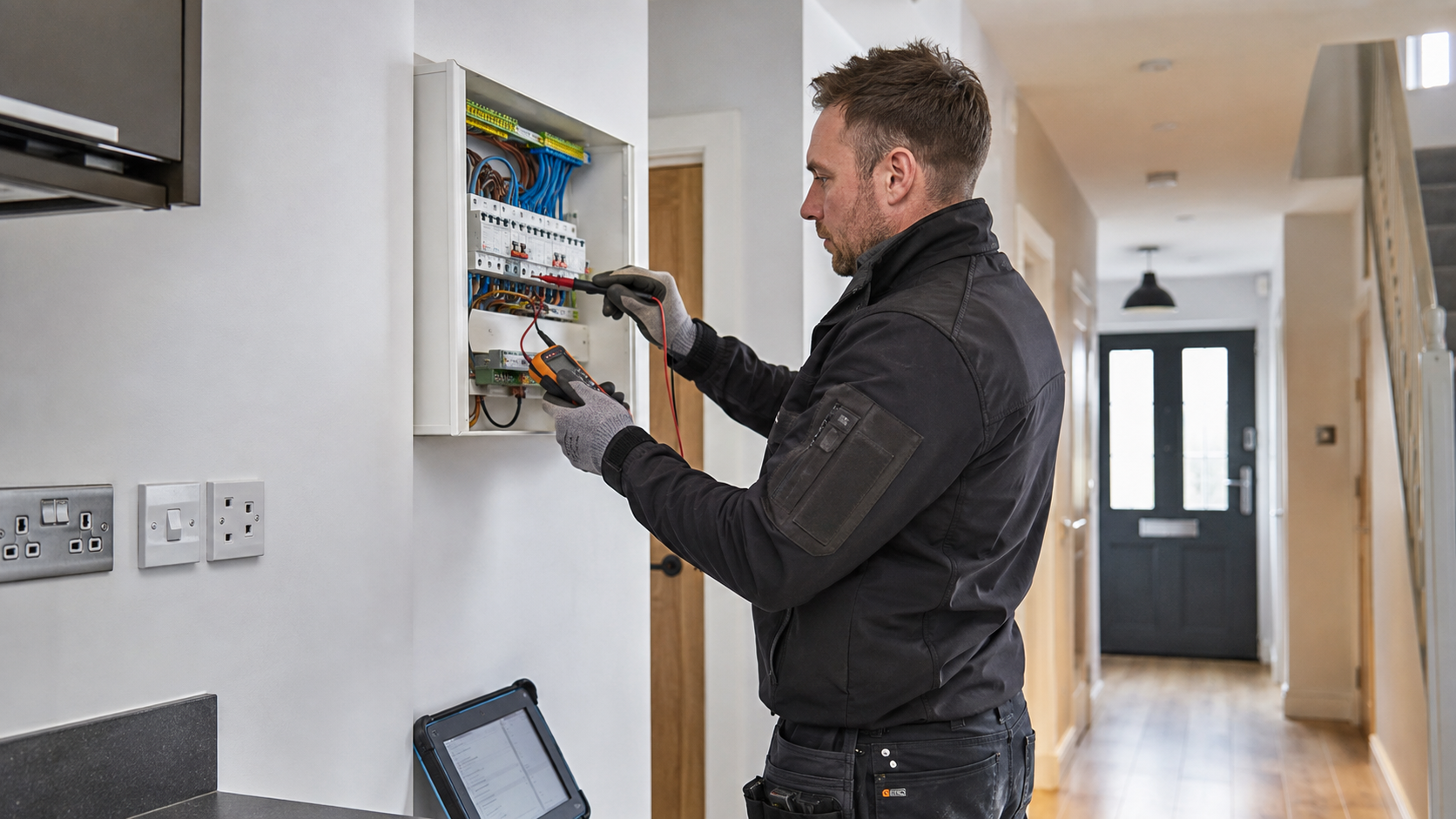
An Electrical Installation Condition Report, commonly known as an EICR, provides a professional assessment of the electrical installation within a property and identifies whether it is safe for continued use.
At LandlordFix, we help landlords and property managers arrange EICR electrical safety inspections through qualified professionals, alongside our wider property maintenance services. LandlordFix currently lists an Electrical Safety Certificate (EICR) as part of its electrical services.
Whether you own one rental flat, an HMO or a larger residential portfolio, understanding your EICR responsibilities can help you protect your tenants, your property and your position as a landlord.
What Is an EICR?
An Electrical Installation Condition Report is produced following an inspection and test of the fixed electrical installation within a property.
The Government confirms that an electrical inspection examines fixed electrical components including:
- Wiring
- Plug sockets
- Light fittings
- Consumer units or fuse boxes
- Permanently connected equipment such as showers
- Extractor fans
- Relevant electrical circuits
The purpose is to identify whether the installation remains safe and whether defects, deterioration or potentially dangerous conditions are present.
An EICR is therefore very different from simply asking whether the lights turn on.
Electrical systems deteriorate over time.
Connections can loosen. Equipment can become damaged. Previous alterations may have been completed incorrectly. Older installations may no longer provide the level of protection expected from modern electrical systems.
An EICR provides a structured assessment rather than relying on appearances.
Is an EICR a Legal Requirement for Landlords?
For most private landlords in England, yes.
Under the Electrical Safety Standards regulations, landlords must ensure that electrical installations in rented properties are inspected and tested by a qualified person at least every five years.
The resulting report is usually an EICR.
Importantly, five years is the maximum standard interval.
If an earlier report specifies that another inspection is required sooner, the landlord needs to follow the shorter interval.
The regulations apply broadly where the occupier uses the property as their only or main residence and pays rent, although specific categories of accommodation are excluded.
If you are uncertain whether the regulations apply to a particular tenancy, specialist advice should be obtained rather than assuming that the property is exempt.
How Often Does a Landlord Need an EICR?
For most applicable rented properties in England, the electrical installation must be inspected and tested:
At least once every five years, or sooner if the previous report requires it.
This does not necessarily mean that a new EICR must be completed every time tenants change.
Government guidance confirms that where a satisfactory inspection was carried out less than five years previously and no further investigative or remedial work is required, another full inspection is not automatically required simply because a new tenancy begins.
However, the new tenant must receive the appropriate existing report.
A visual inspection between tenancies is also sensible because damage or deterioration may have occurred since the previous formal inspection.
The Landlord’s Headache: “When Does My EICR Expire?”
This sounds straightforward when you own one property.
It becomes less straightforward when you manage:
- Several flats
- Multiple HMOs
- Properties bought at different times
- Properties with different inspection dates
- Properties where remedial work has been completed
- Different tenants moving in and out
Suddenly there are certificates, inspection dates, repair documents and tenant records spread across emails, folders and property-management systems.
Missing an expiry date can create a compliance problem that could have been avoided.
How LandlordFix Helps
LandlordFix is designed around making property maintenance easier to organise.
The platform connects landlords with vetted maintenance professionals and provides real-time updates so that property-related work can be managed more systematically rather than through disconnected phone calls and messages.
For landlords arranging an EICR, that means getting the required inspection into the property-maintenance workflow instead of leaving it until the last minute.
What Does an Electrician Check During an EICR?
The inspection is designed to identify risks and defects within the electrical installation.
Government guidance states that an inspection assesses whether there are:
- Overloaded electrical installations
- Potential electric-shock risks
- Fire hazards
- Defective electrical work
- Inadequate earthing
- Inadequate bonding
The electrician will test and inspect relevant parts of the installation and record their findings.
This is why the work must be completed by somebody who is qualified and competent to carry out electrical inspection and testing.
An EICR should not be treated as a paperwork exercise.
The certificate matters because the electrical installation itself needs to be safe.
What Do C1, C2, C3 and FI Mean on an EICR?
One of the most confusing parts of an EICR for landlords is understanding the classification codes.
The Government currently identifies four principal classifications.
C1: Danger Present
C1 means danger is present and there is a risk of injury.
This is the most serious classification.
Immediate action may be required to make the danger safe.
C2: Potentially Dangerous
C2 means the condition is potentially dangerous.
It may not represent the same immediate danger as a C1 defect, but remedial work is required.
C3: Improvement Recommended
A C3 means that an improvement is recommended.
Importantly, a C3 on its own does not mean the EICR is unsatisfactory and does not create the same mandatory remedial requirement as a C1 or C2 classification.
However, landlords may still choose to carry out the recommended improvement.
FI: Further Investigation Required
FI means further investigation is required without delay.
The issue cannot be fully assessed during the initial inspection and requires additional investigation.
If the report records C1, C2 or FI, action is required.
What Happens If My EICR Is Unsatisfactory?
An unsatisfactory EICR does not automatically mean the property needs rewiring.
The report should identify the specific defects or areas requiring investigation.
Where remedial or investigative work is required, landlords generally need to ensure it is completed within:
28 days, or sooner if the report specifies a shorter period.
Once the necessary work has been carried out, appropriate written confirmation or certification should be obtained.
Government guidance identifies examples including:
- A satisfactory EICR
- Electrical Installation Certificate
- Minor Electrical Installation Works Certificate
- Other appropriate electrical certification
This paperwork matters.
Do not simply arrange the repair and assume the problem is finished.
Keep the evidence showing what was identified and how it was rectified.
Do Landlords Need to Give the EICR to Tenants?
Yes.
For properties covered by the regulations, Government guidance currently requires landlords to provide the report:
- To an existing tenant within 28 days of the inspection
- To a new tenant before they occupy the property
- To a prospective tenant within 28 days if they request it
- To the local council within seven days if the council requests it
The landlord should also retain the report for the next inspection.
For a busy landlord, this is why an EICR should not simply be viewed as “booking an electrician”.
There are three parts:
Inspect. Rectify. Document.
All three matter.
What Happens After Remedial Work?
If the EICR identifies work that must be completed, the landlord needs to retain evidence that the problem has been addressed.
Government guidance requires the relevant report and written confirmation following remedial or investigative work to be supplied to the tenant and local council within the applicable timeframe.
For portfolio landlords, keeping a clear digital record for each property can make future inspections considerably easier.
A useful property file might contain:
- Current EICR
- Previous EICR
- Remedial-work certificates
- Electrical invoices
- Relevant tenant correspondence
- Date the next inspection is due
Good property management is often simply good record keeping.
Can a Landlord Be Fined for Not Having an EICR?
Failure to comply with electrical safety duties can have significant consequences.
Current Government guidance states that local councils may impose financial penalties of up to £40,000 for specified breaches of the electrical safety regulations.
Councils can also take action where required remedial work has not been completed.
In certain circumstances, the local authority may arrange necessary work and recover the cost from the landlord.
The practical lesson is simple:
An EICR is considerably easier and cheaper to organise before it becomes a compliance problem.
EICRs for HMO Landlords
Electrical safety is particularly important within Houses in Multiple Occupation.
HMOs may have:
- More occupants
- Greater use of kitchen equipment
- More electrical devices
- More bedrooms
- Shared communal facilities
- Increased demand on sockets and circuits
Government guidance confirms that the electrical safety regulations apply to properties occupied by people from different households who share facilities, including HMOs.
For an HMO landlord, electrical safety should therefore form part of a wider compliance and property-maintenance programme rather than being treated as a once-every-five-years administrative event.
Depending on the type and location of the HMO, other licensing and safety obligations may also apply.
EICR vs PAT Testing: What’s the Difference?
These two terms are frequently confused.
An EICR examines the fixed electrical installation.
That includes things such as:
- Wiring
- Sockets
- Lighting circuits
- Consumer units
- Permanently connected equipment
Portable appliance testing relates to electrical equipment and appliances rather than the property’s fixed wiring.
Examples might include:
- Kettles
- Toasters
- Lamps
- Portable heaters
- Other plug-in equipment
An EICR therefore does not mean that every portable electrical appliance in the property has been tested.
The two checks address different areas of electrical safety.
Does a New-Build Property Still Need an EICR?
Not always immediately.
Where a home is newly built or has been completely rewired, an Electrical Installation Certificate (EIC) may initially satisfy the relevant requirement.
Current Government guidance states that where an appropriate EIC has been issued, the landlord may not need another inspection for five years, provided the relevant regulatory requirements have been met.
Landlords should retain the certificate carefully.
Losing compliance documents creates unnecessary work later.
Does a New Tenant Mean I Need Another EICR?
Not necessarily.
If:
- The existing report is still within its required inspection period
- No further investigative work is outstanding
- No remedial work remains outstanding
then a new full electrical inspection is not automatically required simply because the tenant changes.
However, the incoming tenant must receive the current report before occupying the property.
Government guidance also recommends a visual check before a new tenancy to make sure there has not been obvious deterioration or damage since the previous inspection.
What If a Tenant Refuses Access for an EICR?
Access can be one of the biggest practical problems landlords face.
A landlord may book the inspection.
The tenant cancels.
Another appointment is arranged.
Nobody answers.
This can become frustrating, but landlords should keep clear records showing their attempts to comply.
Government guidance states that landlords may be able to demonstrate that they took all reasonable steps by retaining communications showing their attempts to arrange access.
That could include:
- Emails
- Messages
- Appointment confirmations
- Written notices
- Records of cancelled appointments
The important point is to act early.
Waiting until the certificate is about to expire leaves very little room to deal with access problems.
When Should You Arrange Your EICR?
Do not wait until the final week before the existing report expires.
A sensible approach is to review the certificate in advance.
This allows time for:
- Booking the qualified professional
- Arranging access with the tenant
- Completing the inspection
- Reviewing the report
- Completing any necessary remedial work
- Obtaining confirmation
- Providing documents to the tenant
If you own multiple properties, consider reviewing all EICR expiry dates together rather than dealing with each one reactively.
That turns electrical compliance into a scheduled process rather than an emergency.
Why Use LandlordFix for Your EICR?
LandlordFix is designed specifically around landlords and property maintenance.
The platform currently offers an Electrical Safety Certificate (EICR) service and describes its purpose as helping ensure that a property’s electrical system is safe and compliant.
Vetted Professionals
LandlordFix connects property owners with vetted maintenance professionals, with its website stating that maintainers are screened and that professionals using the platform are licensed and insured where applicable.
For electrical inspection work, using a properly qualified and competent person is essential.
Easier Property Maintenance
Electrical certificates often sit alongside numerous other landlord responsibilities.
LandlordFix is built to make those jobs easier to coordinate through one property-maintenance platform.
Real-Time Job Updates
The platform provides real-time tracking so landlords can monitor maintenance requests and see progress rather than repeatedly chasing contractors for information.
Designed Around Landlords
LandlordFix is not simply a directory of tradespeople.
Its services are designed around rental-property maintenance and the practical requirements of landlords and property managers.
The Bigger Picture: EICR Is Part of Good Property Management
Compliance should not simply be about avoiding a fine.
A professional landlord wants to know that the property they provide is safe.
Electrical systems sit behind walls, beneath floors and inside consumer units. Problems may not announce themselves until they become serious.
Regular professional inspection provides an opportunity to identify deterioration and potential hazards before they develop further.
For landlords, an EICR therefore provides three important things:
Safety.
A qualified professional assesses the electrical installation.
Documentation.
You receive a formal record of the property’s electrical condition.
Compliance.
For relevant rented properties, the inspection helps you fulfil an important legal responsibility.
Take the Electrical-Safety Headache Off Your List
Being a landlord already means managing tenants, repairs, cleaning, maintenance, certificates and changing legislation.
An EICR should not become another deadline that gets buried in the calendar.
LandlordFix can help you arrange an Electrical Installation Condition Report through qualified professionals, making electrical safety checks part of a more organised approach to property maintenance.
Whether you manage one residential property or a portfolio of rental homes, keeping electrical inspections up to date protects more than your paperwork.
It helps protect the people living in your property.
Need an EICR for your rental property? Arrange your electrical safety inspection with LandlordFix.
Frequently Asked Questions About EICRs
What does EICR stand for?
EICR stands for Electrical Installation Condition Report. It records the findings of a professional inspection and test of the fixed electrical installation within a property.
Is an EICR compulsory for landlords?
For most applicable rented homes in England, landlords are required to have the electrical installation inspected and tested by a qualified person at least every five years.
How long does an EICR last?
The normal maximum interval is five years, although the report may specify that another inspection must be carried out sooner.
Does an EICR need to be done every time a tenant changes?
No, not automatically. Where a valid report remains in place and there is no outstanding investigative or remedial work, Government guidance says a completely new inspection is not required simply because the property is re-let. The current report must still be provided to the new tenant.
What makes an EICR unsatisfactory?
C1 and C2 classifications result in an installation being considered unsatisfactory for continued use until the relevant problems are addressed. An FI classification also requires further investigation.
Does a C3 mean the EICR has failed?
No. C3 means improvement recommended. Government guidance states that further remedial work is not required solely because of a C3 for the report to be considered satisfactory.
How quickly must EICR remedial work be completed?
Required remedial or investigative work generally needs to be completed within 28 days, or sooner where the report specifies a shorter timeframe.
Do I have to give my tenant a copy?
Yes. Existing tenants should generally receive the report within 28 days of the inspection, while new tenants must receive it before occupying the property.
What can happen if a landlord does not comply?
Current Government guidance states that local councils may impose financial penalties of up to £40,000 for specified breaches of the regulations.
Does an EICR test appliances?
An EICR primarily concerns the property’s fixed electrical installation, including wiring, sockets, light fittings, consumer units and permanently connected equipment. It should not be confused with testing portable electrical appliances.
Can LandlordFix arrange an EICR?
Yes. LandlordFix currently lists Electrical Safety Certificate (EICR) among its electrical services and connects landlords with vetted property-maintenance professionals.